
This article was originally published by NZ Adviser.
The idea of a ‘typical’ borrower is becoming increasingly difficult to define. Alongside traditional PAYE applicants, advisers are working with self-employed clients, business owners, property developers, returning New Zealanders, migrants and investors with income and assets spread across multiple entities.
Family and property arrangements are also changing. Multi-generational households, blended families, business succession, relationship separations and borrowers purchasing with others can all add further layers to an application.
Ian Boyce, General Manager of Property at Avanti Finance, says the difficulty for many of these borrowers is not necessarily the strength of their position. Instead, it is whether a lender’s processes allow that strength to be recognised.
“The challenge for these borrowers is often not credit quality, but lenders’ ability to assess their circumstances holistically.”
“As a specialist lender, we take a pragmatic approach to credit assessment, working closely with advisers to understand the full picture, including serviceability, security arrangements, repayment plans and exit strategy. This allows us to identify strengths and mitigants that may not be immediately apparent and find a pathway forward that helps the client achieve their goals.”
Borrower circumstances are moving beyond standard income calculations
Economic pressures are also contributing to separation and property buyout situations. In these cases, the borrower’s equity, security and history of meeting commitments may be as important as the result produced by a standard income calculation.
“This trend is likely to continue. For advisers, it reinforces the importance of understanding the full client story, clearly communicating strengths and mitigants, and recognising when flexibility, speed, and a tailored approach may deliver the best outcome.
“And for lenders, it requires the expertise to assess all the moving parts, ask the right questions upfront and structure solutions that meet the needs of borrowers while maintaining responsible lending standards.”
Advisers need the full context of complex applications
Assessing a complex borrower requires advisers to look across the client’s entire financial position. That can include their different income sources, account conduct, equity, security, business interests, repayment strategy and the reasons behind any unusual transactions or recent financial events.
Avanti Finance recently worked with experienced property investors refinancing a completed mixed-use redevelopment. The clients wanted to retain six newly created apartments as long-term rentals but were self-employed and received both local and overseas rental income. Main banks viewed the property as commercial and offered only higher-priced, short-term options.
“The adviser approached us with a well-prepared and clearly documented application, allowing us to fully understand the clients’ financial position and identify several mitigants.
“As a result, we were able to support the clients’ transition from development finance to a long-term investment strategy, helping them retain the completed apartments as part of their rental portfolio.”
The lesson for advisers is that complexity should be explained rather than left for an assessor to uncover. Information about related parties, ownership changes, connected businesses, unusual income movements and financial commitments can prevent unnecessary questions and delays.
Specialist lending becomes a strategy, not a last resort
As borrower profiles become more varied, specialist lending is moving closer to the centre of the lending landscape. Its value is not simply in approving applications that a bank has declined, but in offering structures aligned with a client’s immediate circumstances and longer-term goals.
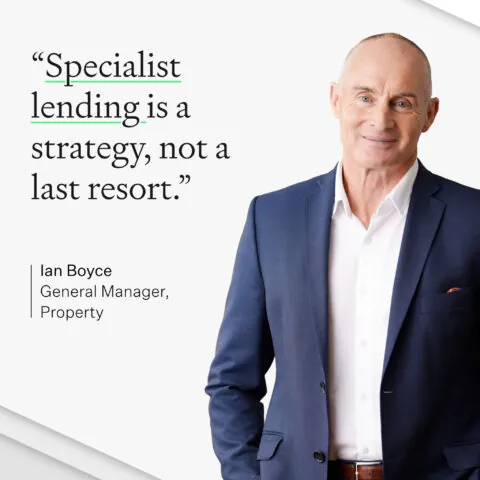
“Rather than positioning specialist lending as a ‘Plan B’, advisers should consider at the outset whether it is the best solution for a client’s current circumstances. Many borrowers who fall outside standard bank criteria still have strong lending propositions, but their circumstances require a more flexible and nuanced assessment,” says Boyce.
“Many successful business owners, property investors, developers and home buyers use specialist lending because it offers flexibility that better aligns with their needs. Sometimes it helps a client achieve an immediate objective while creating a pathway back to mainstream lending in the future.
“That’s a strategy, not a last resort.”
